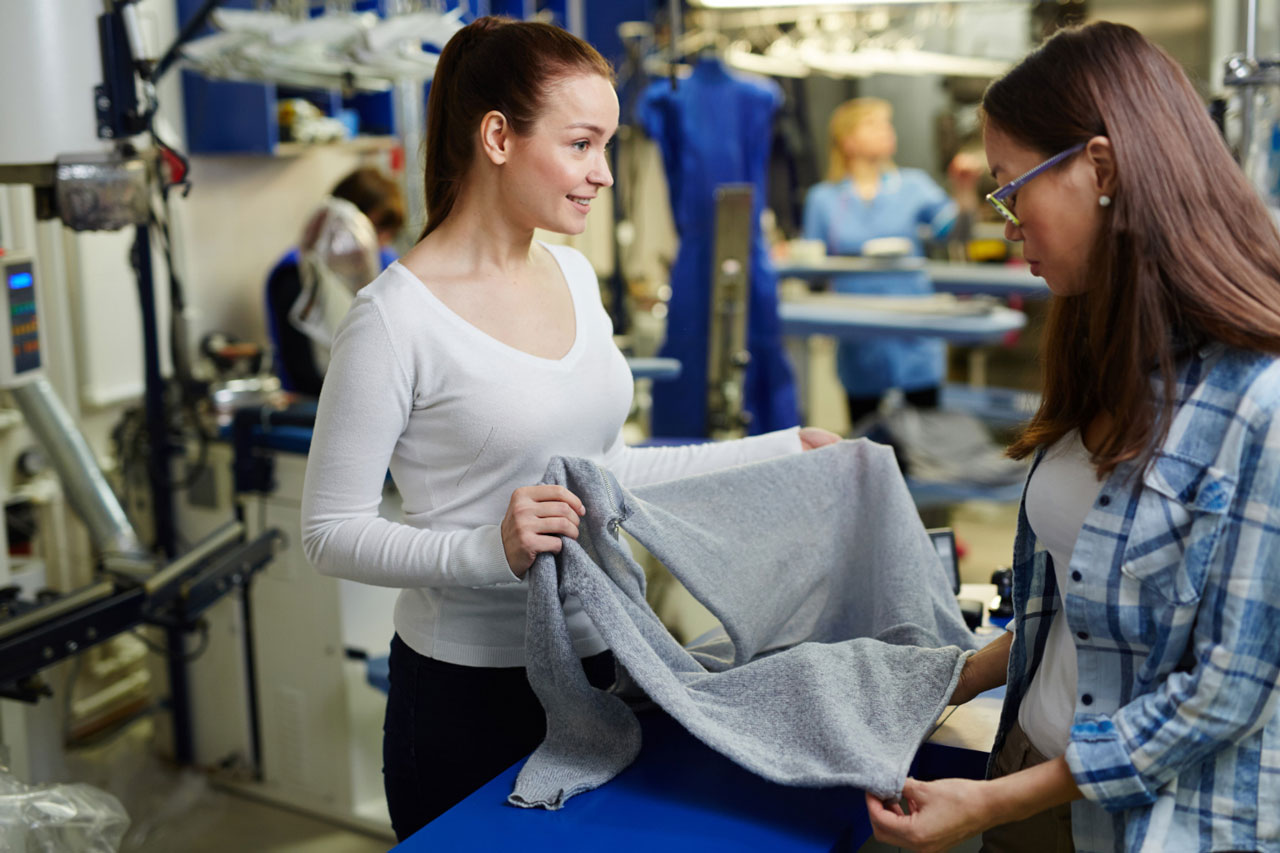
The ironing process is a crucial stage in the textile industry and other manufacturing sectors, having a major impact on the quality of finished products and, above all, on consumer perception. For example, in the textile industry, ironing removes creases and ensures a uniform appearance of the fabrics. According to a study carried out by the Textile Research Journal, professionally ironed textile products are rated up to 35 per cent more favourably by potential buyers than those that have not been ironed.
Furthermore, efficient ironing processes significantly reduce manufacturers’ operational costs:
✅ The rejection rate of products due to poor appearance falls by approximately 18% when automated ironing processes are implemented.
✅ Production time can be reduced by up to 12% by integrating modern ironing equipment into production lines.
The benefits of the ironing process across various industries
The fashion and clothing industry
✅ Around 87 per cent of consumers consider the ironed appearance of garments to be an important indicator of quality, according to a survey carried out by Fashion Business International.
✅ Retailers report a 22% increase in sales for items that have undergone a professional ironing process.
The hospitality industry
✅ Hotels that use professional ironing systems for linen report a 15–20 per cent higher customer satisfaction score.
✅ The lifespan of hotel textiles increases by 25–30 per cent when they are properly cared for, including through ironing.
Automotive industry
✅ In the production of car upholstery, ironing and heat-pressing processes reduce the defect rate by approximately 23%.
✅ Assembly time for textile components in cars is reduced by 17% when materials are pre-ironed.
Implications for sustainability
✅ Automated ironing systems reduce energy consumption by up to 30% compared with traditional methods.
✅ Modern industrial ironing processes consume 25–40 per cent less energy than those used in the 2000s.
✅ State-of-the-art steam irons reduce water consumption by approximately 35 per cent.
Manual or automated ironing?
The decision between manual and automatic ironing is a major dilemma for manufacturers in the textile industry and other related sectors. This choice directly influences operational costs, process efficiency and the quality of finished products.
Impact on costs
Manual ironing
✅ Low initial cost (cheaper equipment).
✅ High labour costs (accounting for 65–75 per cent of the total cost).
✅ Variable energy consumption, depending on the operator. The technology used in VEIT ironing equipment reduces consumption by up to 25 per cent compared to the market average.
✅ Hidden costs associated with worker fatigue and potential accidents. The ergonomic design of VEIT irons minimises operator fatigue and the risk of accidents.
Automatic ironing
✅ Significant initial investment.
✅ Reduced long-term operating costs (savings of 30–40% over 3–5 years).
✅ Optimised and predictable energy consumption.
✅ Regular maintenance required. Whilst the industry average is 3–5 per cent of the annual equipment cost, VEIT ironing systems require only 1.5–2.5 per cent thanks to their modular design and high-quality components.
Impact on efficiency
Manual ironing:
✅ Limited capacity (40–60 items per hour for an experienced operator).
✅ High flexibility for small and varied batches.
✅ High dependence on the operator’s experience.
✅ Variability in processing time.
Automatic ironing:
✅ Increased productivity (200–600 items per hour, depending on the system).
✅ Optimal efficiency for large, standardised batches.
✅ Allows for continuous operation (24/7).
✅ Longer initial set-up time, but consistent processing.
Impact on quality
Manual ironing:
✅ Variable quality, dependent on the operator. The design of any VEIT industrial iron reduces operator fatigue by up to 40%, maintaining consistent quality throughout long shifts.
✅ Adaptability to delicate or complex materials. VEIT irons have a very important feature that helps the operator iron the product with precise temperature control. On the HP2003 industrial iron, the temperature is controlled electronically (VEITRONIC), with a maximum tolerance of ±1 °C. Precise temperature control of the soleplate helps when ironing the most delicate fabrics. A standard iron, which is controlled by a bimetallic thermostat, has a high tolerance of ±15–20 °C, which results in inconsistent temperature and, consequently, inconsistent quality.
✅ Potential inconsistencies between different operators. At TeXco, we have integrated a training system that reduces inconsistencies between different operators through real-time guidance.
✅ Better control over fine details and problematic areas. VEIT ironing equipment features unique attachments for problematic areas, offering superior control compared to standard solutions.
Automatic ironing:
✅ High consistency across products (variation under 5%). Unlike the average performance of other automatic ironing lines, VEIT ensures exceptional consistency and a variation of under 2% between products, compared to the market average of 5%.
✅ Precisely controlled parameters (temperature, pressure, time). VEIT’s German technology delivers accuracy of 0.5°C for temperature and 5 g/cm² for pressure.
✅ Greater adaptability for non-standard items. VEIT’s unique system adjusts to non-standard materials, overcoming the usual limitations of automation.
✅ Consistent results, independent of human factors. The uniform heat distribution of VEIT’s automatic industrial ironing equipment ensures consistent results, even after thousands of cycles of use.
How do you choose between manual and automatic ironing?
To make the best choice between manual and automatic ironing, several critical factors must be assessed.
Total cost analysis
⚠️ Initial investment: VEIT’s Uniset and Uniset DB manual ironing systems require a significantly lower initial capital outlay compared to the BRI-1005 VC/BRI-1105 VC, which entails a substantially higher investment in specialised technology and equipment.
⚠️ Operational costs: The VEIT BRI-600/201 Premium automated systems reduce labour costs by up to 70% and energy consumption by 25% compared to manual solutions.
⚠️ Long-term savings. For production of over 500 items per day, the BRI-1920/101 Premium automated pressing system for finishing various garments pays for itself in less than 18 months.
Scalability of the production process
✅ Small volumes. For production runs of under 200 units per day, the VEIT Uniset S Basic manual system with an ergonomic ironing table may be the optimal solution.
✅ Medium volumes. The semi-automatic BRI-500/101 Classic system allows you to double capacity whilst maintaining the same production floor space.
✅ High volumes. The fully automated BRI-585C/101 Premium line can process up to 90 pieces per hour, making it ideal for growing production volumes.
Product type and process complexity
✅ Simple products. For items such as sheets, the VEIT Varioline S+B Classic ironing table with assisted functions is sufficient.
✅ Complex products. For finishing suits and jackets, the BRI-1200/101 Premium automated system with 9 programmable zones ensures the necessary precision.
✅ Specialised products: The BRI-222 VC trouser ironing line combines automation with manual stations for fine details.
The need for flexibility
✅ Wide range of products. The BRI-2000 VC universal pressing system allows for rapid reconfiguration between different types of garments.
✅ Small batches. The BRI-2068 SC modular solution offers the flexibility of manual ironing with the partial efficiency of automation.
✅ Customisation. The VEIT 8363 Classic steam finishing mannequin with adjustable programmes allows for an adaptive approach to small and varied batches.
Assessment of available human resources
✅ Limited staff availability. The VEIT BRI-905C/101 Premium line reduces the need for skilled operators.
✅ Training and expertise. Systems with colour touchscreen control panels reduce training time for new operators.
✅ The impact of labour costs. As wages rise year on year, the BRI-1810/302 Classic automated industrial press systems significantly reduce the cost per unit.
When is it best to combine the two methods?
Combining manual and automated ironing is a smart strategy for optimising textile production processes, striking a balance between efficiency and quality. Here’s how you can integrate both approaches using VEIT solutions:
1. Separation according to production stages
Automatic intermediate ironing + manual finishing: the BRI-585 VC automatic system for opening the centre and side seams of the back can be combined with the VEIT Uniset CN S 130×65 Basic manual ironing table for finishing fine details.
✅ Guaranteed efficiency. This combination increased productivity by 35% at a premium suit manufacturer, whilst maintaining high quality standards.
2. Separation based on product complexity
Standard products processed automatically + complex products processed manually: for a clothing manufacturer producing both standard uniforms and bespoke suits, using the BRI-1200/101 Premium automated system for standard products and the VEIT Varioline S+B Classic manual system for bespoke items optimises the production flow.
✅ Guaranteed efficiency. Operating costs fell by 22% and scrap by 15% in the first 6 months following implementation.
3. Examples of efficient hybrid systems
Hybrid ironing systems for suits and jackets
- Automation for high volumes: Use of the BRI-600/201 Premium press system for the front of jackets, which processes 85 garments per hour.
- Manual ironing for finishing: Complemented by the VEIT Varioset Premium ironing table for the manual finishing of linings and fine details, ensuring premium quality.
- Proven results: A European manufacturer reported an 18 per cent increase in quality and a 25 per cent reduction in production time.
The solution for factories with varied designs
- The VEIT hybrid system: Combining the BRI-1810/302 Classic model for finishing sleeves and processing armholes with the VEIT Uniset S Classic ironing table for complex seams.
- Increased flexibility: This system allows switching from one model to another in less than 10 minutes, compared with 45 minutes on fully automated lines.
- Financial impact: It reduces the initial investment by 40% compared to a fully automated line, whilst retaining 75% of the productivity benefits.
Seasonal approach
- Automated peak season: Use of the BRI-1920/101 Premium shoulder finishing press system during periods of high volume.
- Manual low-volume production: Switch to the VEIT Uniset CN S Basic during periods of low volume.
- Economic benefits: A 30% reduction in operational costs during periods of low volume, whilst maintaining the ability to scale up production rapidly when necessary.
Hybridising the ironing process using VEIT technologies allows companies to benefit from the efficiency of automation for repetitive operations and the precision of manual ironing for the details that make the difference in perceived quality, adapting perfectly to the demands of the modern market.
How TeXco helps you turn the ironing process into a business advantage
As an authorised VEIT distributor, TeXco offers you more than just equipment – it offers solutions tailored to your specific needs.
Our assessment process is simple and efficient. We visit your premises, analyse your current production workflow and identify opportunities for improvement. You don’t have to carry out this analysis yourself, as it is the responsibility of our experts.
We use VEIT tools to calculate exactly how much you’ll save by optimising your ironing processes, and we present you with clear figures on costs, savings and the payback period, as we believe that good decisions are made on the basis of concrete data.
What’s more, the TeXco plan goes beyond simply selling equipment. Specifically, we offer you a 3–5-year strategy that includes:
- the gradual implementation of VEIT technologies without interrupting production;
- staff training to maximise equipment performance;
- maintenance services to evaluate results and adjust the strategy.
The VEIT solutions offered by TeXco reduce your operational costs, increase productivity and improve product quality. Furthermore, modern technologies such as eMotion and Grid Plates reduce energy consumption and minimise waste.
With TeXco, choosing between manual and automatic ironing becomes a simple and strategic decision. Our aim is to offer you the best solution, one that delivers immediate benefits and supports the long-term growth of your business.
Contact us today for a free assessment and discover how VEIT technology, implemented by TeXco, can grow your business and increase your profits!