Evaporative cooling is a method of cooling air in which water is used to lower the temperature through evaporation, rather than mechanical compression. Compared with compression refrigeration, evaporative cooling can consume considerably less electricity. However, its performance and energy efficiency depend on climatic conditions, the system configuration and the application in which it is used.
In this article, we explain how it works, the differences between direct and indirect systems, the applications in which it excels, and the situations in which this technology is not the best choice.
Why does evaporation cool?
It all starts with a simple physical phenomenon: the evaporation of water absorbs thermal energy from the air. To change from a liquid to a gaseous state, water requires heat, which it draws from its surroundings. Consequently, the air temperature drops.
Unlike compression refrigeration, evaporative cooling does not use compressors or refrigerants to lower the air temperature. Electricity is mainly consumed by fans, pumps and control systems, depending on the system’s configuration.
However, the system does consume water, and the amount required is not a fixed value. This is calculated based on the air flow rate, the temperature and humidity of the outside air, the efficiency of the equipment and the desired outlet conditions. Evaporation can take place on an evaporative surface or through the controlled atomisation of water, depending on the technology used.
The system’s performance, however, depends on the relative humidity of the air. The drier the air, the more water vapour it can hold, and the more intense the evaporation process. Conversely, when the air is already nearly saturated with moisture, the cooling effect decreases considerably.
During periods when the outside air is hot and dry, evaporative cooling can achieve significant temperature reductions. However, the suitability of the solution must be verified using the site’s climate data and the temperature and humidity limits accepted for that space.
The temperature difference that can be achieved depends on the wet-bulb temperature and the efficiency of the system. On a very hot and dry day, the air can be cooled by several degrees before being introduced into the space. As outdoor humidity increases, the evaporation potential decreases, and the temperature reduction becomes smaller.
For this reason, performance must be estimated for the actual climatic conditions at the site, rather than determined solely on the basis of the outdoor temperature.
Direct evaporative cooling vs. indirect evaporative cooling
Although the physical principle is the same, the way in which water comes into contact with the air divides evaporative cooling systems into two categories:
- Direct evaporative cooling, where the air passing through the wet medium is exactly the same air that reaches the space of use.
The air is cooled and humidified simultaneously, as the vapour resulting from evaporation remains within the same air flow. This is the simplest solution, offering the best energy efficiency, but it has a side effect that must be taken into account: it increases the relative humidity in the hall or room in question.
It may be a suitable solution for halls, warehouses or agricultural spaces where the additional humidity is acceptable and there is adequate ventilation of the air from the space. - Indirect evaporative cooling, which operates using two separate air streams. The first stream passes through the wet medium and is cooled by evaporation, just as in direct evaporative cooling, but this air never reaches the target space.
The evaporatively cooled air flow passes through a heat exchanger, where it absorbs heat from the second air flow. The two flows remain separate, and the air introduced into the room is cooled without direct contact with water and without any direct addition of moisture.
The result: the air is cooled without being humidified. This variant can be used where the production or storage process does not allow the introduction of additional moisture, for example in certain electronic or food applications, or in warehouses storing hygroscopic materials.
Criterion | Direct evaporative cooling | Indirect evaporative cooling |
Humidity in the cooled space | Increases | The air is not directly humidified |
Equipment complexity | Simple | More complex (heat exchanger, dual-flow) |
Energy efficiency | Very high | High, but slightly lower than direct evaporative cooling |
Temperature drop | Generally greater | Generally more moderate |
Recommended for | Halls, warehouses, agricultural premises, general comfort | Applications where direct addition of moisture is not acceptable |
Where is evaporative cooling used?
Due to its low energy consumption and high treated air flow rate, evaporative cooling is mainly used in three types of applications.
✅ Production halls, warehouses, logistics centres. The large volumes of air required in industrial halls or logistics centres would make mechanical air conditioning very costly. Evaporative cooling can simultaneously provide cooling and a high flow of fresh air, with lower electricity consumption than that of refrigeration solutions used for comparable volumes.
✅ Open or semi-open spaces, such as terraces, halls with permanently open doors, or areas with heavy footfall and goods traffic, are difficult to cool using conventional systems, as the cooled air is quickly lost to the outside. Evaporative cooling works differently: it continuously introduces fresh, cooled air, without relying on the space being airtight.
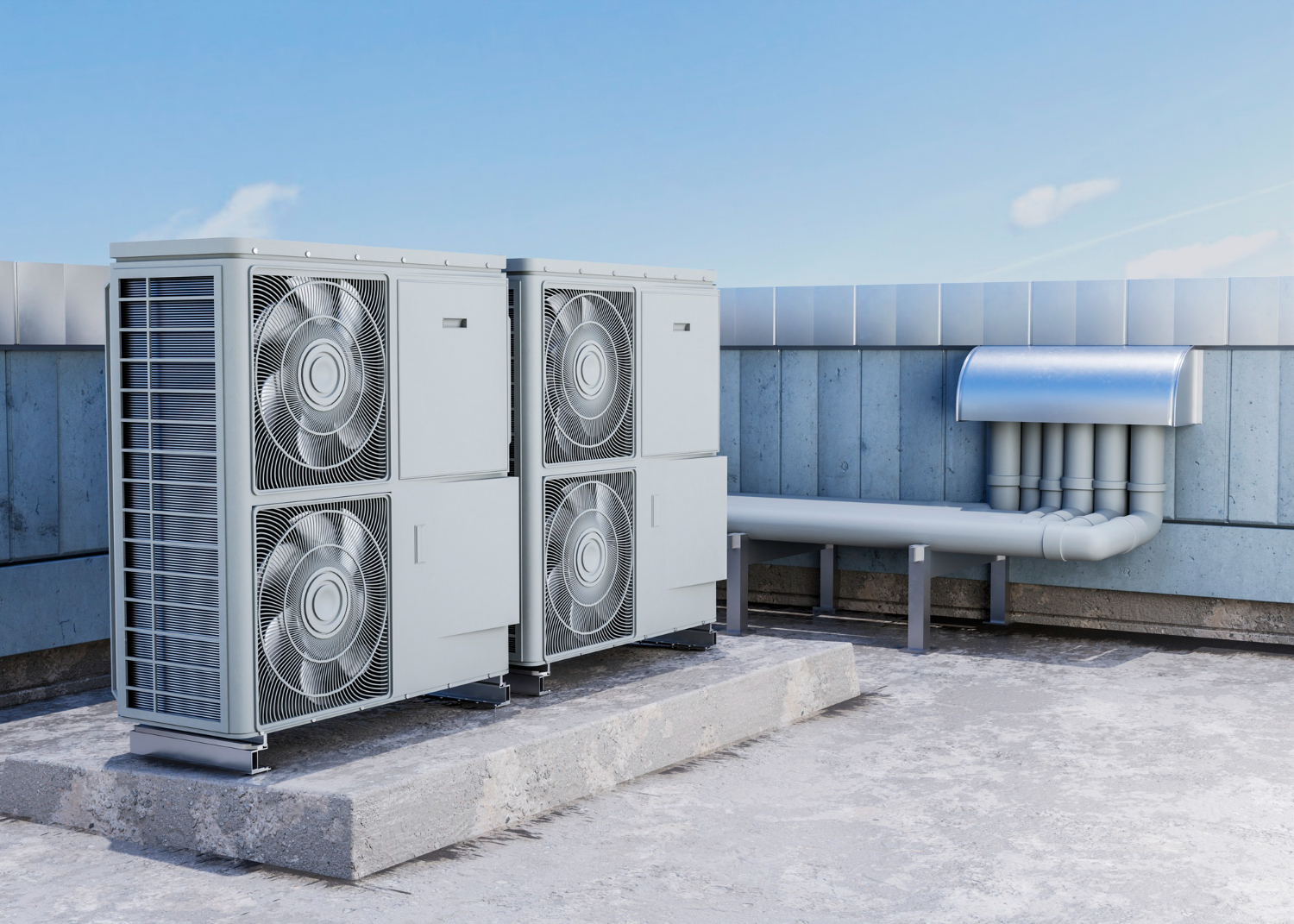
✅ Pre-cooling of air-cooled chillers and air-cooled cooling coils (dry coolers). Outside air is passed through an evaporative system before reaching the chiller’s condenser or the dry cooler’s coils.
In this configuration, evaporative cooling does not replace the main equipment, but reduces the temperature of the intake air. During very hot periods, this can improve cooling capacity and reduce the system’s energy consumption.
The efficiency of the solution depends on the temperature and humidity of the outside air, the configuration of the main equipment and the design of the pre-cooling system. The efficiency of this application is influenced by climatic conditions, particularly the humidity of the outside air.
When is the efficiency of evaporative cooling limited?
Evaporative cooling does not deliver the same results under all conditions. Performance must be assessed in relation to the outdoor air humidity, process requirements and how the air is extracted from the space.
- Outdoor air with high humidity. As the outdoor air becomes more humid, its capacity to absorb water vapour decreases. The temperature difference achieved through evaporation thus becomes smaller, and the system may fail to meet the required conditions in that space.
- Processes that do not allow for increased humidity. Direct evaporative cooling is not suitable when materials, products or equipment cannot tolerate the addition of moisture. In such situations, an indirect option, a hybrid solution or a refrigeration system with more precise control may be considered.
- Spaces without adequate air extraction. In the case of direct cooling, the air introduced must be able to be extracted. If the space is enclosed and humid air accumulates, cooling efficiency decreases and humidity levels may rise above acceptable limits.
- Applications requiring very precise control. Certain industrial, pharmaceutical, food or electronic processes require strict temperature and humidity limits. In such cases, evaporative cooling may play a complementary role, but does not automatically replace air-conditioning systems with active control of both parameters.
Assessing operating conditions prior to design is essential for selecting the appropriate technology and for realistically estimating performance.
What equipment is used for evaporative cooling?
The mechanism described is put into practice using dedicated equipment, with dimensions varying according to the type of space.
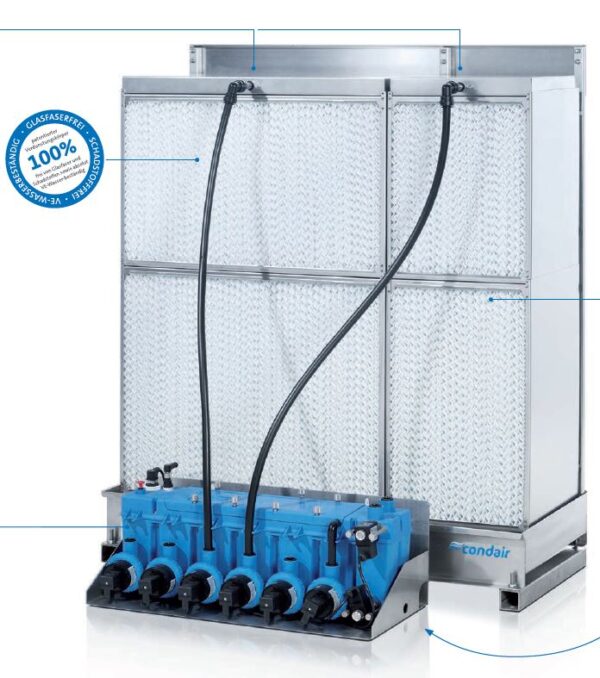
Condair ME is an evaporative system designed for integration into an air-handling unit or a ventilation duct. Air passes through a moist medium, where some of the water evaporates, thereby reducing the temperature of the air flow.
The system can be used for humidification and direct evaporative cooling, or it can be integrated into an indirect cooling configuration, depending on the design of the air handling unit.
- Humidification & dehumidification
Condair HP is a high-pressure adiabatic system designed for integration into air handling units or ventilation ducts. Treated water is sprayed through high-pressure nozzles, and its evaporation reduces the air temperature.
The configuration includes the components required to control the atomisation and to separate any droplets that have not evaporated before the air leaves the treatment section.
The choice between the Condair ME and Condair HP depends on the configuration of the air handling unit, the required capacity, the space available for evaporation, water quality, control requirements, and operating and maintenance conditions.
Correct equipment sizing, together with the calculation of actual electricity consumption, is covered in the article dedicated to summer energy consumption.
Evaporative cooling and the risk of Legionella
Recent cases of Legionella associated with cooling towers have once again highlighted the importance of maintaining water-using installations. These incidents do not mean that all evaporative cooling systems pose the same risk. The mode of operation differs between cooling towers, systems using an evaporative medium and systems that atomise water via nozzles.
The microbiological risk depends on water temperature and quality, stagnation periods, the formation of biofilm or deposits, how aerosols are generated and controlled, and the maintenance of the system.
Condair ME uses an evaporative medium and does not rely on spraying water into the air stream. Condair HP utilises water atomisation via high-pressure nozzles and requires appropriate water treatment, droplet separation, controlled draining and flushing cycles, and adherence to the maintenance schedule.
Prevention involves correct system design, using water of the quality specified by the manufacturer, regular cleaning and disinfection, avoiding stagnation, and regular checks of components.
Frequently asked questions about the installation and operation of evaporative cooling
Can evaporative cooling be integrated into an existing HVAC system?
Yes, in many cases it can be added to an air handling unit, a ventilation duct or the intake area of existing refrigeration equipment. Before installation, the available space, air flow rate, pressure drop, water drainage and compatibility with the automation system must be checked.
What type of water is required?
Requirements vary depending on the technology. High-pressure nozzle systems generally have stricter water treatment requirements than evaporative systems. Water quality affects the formation of deposits, the service life of components and the hygiene conditions of the installation.
Can evaporative cooling cause condensation or corrosion?
A system that is incorrectly sized or controlled may raise humidity levels above acceptable limits and promote condensation on cold surfaces. Therefore, the design must take into account the dew point, surface temperatures, materials in the space and the process’s humidity limits.
What maintenance work is required?
Maintenance may include checking water quality, cleaning the evaporative media, nozzles and droplet separators, removing deposits, checking drainage and carrying out periodic sanitisation. The frequency depends on water quality, the number of operating hours and the manufacturer’s requirements.
Does installation require production to be halted?
It depends on where the system is integrated. Some pre-cooling solutions installed outdoors may require minimal work on the production hall, whilst integration into an air-handling unit may require a planned shutdown window. This aspect must be established as early as the technical assessment stage.
Conclusion
Evaporative cooling can be an energy-efficient alternative to refrigeration-based cooling in industrial halls, warehouses, agricultural premises and other applications involving large air volumes, but only when selected according to operating conditions and correctly sized.
If you wish to compare the energy consumption of evaporative cooling with that of chillers and other cooling solutions, or if you need assistance in selecting the right equipment, request a technical assessment from Texco’s specialists.